

| Now available on YouTube! Grooming a Pumi Video In 2006 we videoed a normal trimming session on Bela, and turned it into a learning tool. This covers the scissor work, not the combing. Someday I’ll do one on combing, too. Click here to see it |

I have been breeding and showing dogs for 50 years, but have had Pumis since 1999. I am an expert in grooming Miniature Schnauzers, but when faced with a hairy Pumi, had no idea what to do with him. I hope this helps those who are new to the breed and desperate for more information on the Pumi that is written in English. Many thanks to Tamara Langer for the illustrations.
The ideal Pumi coat is elegant, neither too long nor too short, suitably thick, curly, and it is made up of very nice “locks of hair”. The coat can be maintained quite easily by combing (not brushing) the coat every week or two. After being combed, the Pumi must be bathed or “wetted down” and left to dry on its own. Never brush and blow dry the hair which takes away the curly locks of hair that is a Pumi characteristic.

Pumi breeder Tamara Langer described the best way to see what the Pumi hair should look like is to take your dog swimming for five days in a row and each time let him dry naturally. Then his hair will take on the correct characteristics. The Pumi does not shed, but must be trimmed and/or plucked every 2-4 months to keep him looking tidy. The correct look of the Pumi should govern how he is trimmed, so let’s take a brief look at the standard of perfection for the Pumi. The Pumi is a square dog – he should be the same length from his withers to the ground as he is from the forechest to the buttocks. The sides of the body are rather flat (not rounded or barrel-shaped). The withers are clearly noticeable, the back line slopes slightly. He has a high-set tail curled over the back, a relatively narrow, wedge-shaped head with very little stop, and high-set, semi-erect ears, with about 1/3 of them folding over. His legs should be straight when viewed from the front or rear, with moderately angulated shoulders and rear. OK, now how does that translate to grooming?
Order of grooming
- Brush
- Comb
- Pluck (if you comb vigorously, removing hair, you can probably skip this step)
- Bathe or wet down with a spray bottle. For the best effect, only pat them dry with a towel, do not rough up the hair with the towel.
- Let dry (quite often I bathe one day and scissor the next day)
- Scissor
Combing
First, comb him out thoroughly. You should be able to easily comb through his hair any direction. You may get quite a bit of hair out, but that’s good – new hair will come in to replace it. The new hairs will be a little thicker and coarser and easier to take care of in the future. I’ve found that the brush shown below will help take out most of the tangles and then you can follow up with the comb.
Be sure to get clear down to the skin when brushing and combing. It’s best to “line comb”: hold some of the hair in one hand and comb or brush a bit out of your hand with the other hand.
Bathing
After combing, bathe your Pumi. When finished bathing, pat your dog dry with a towel and let him air dry on his own. This will allow his naturally curly hair to curl back up again. Bathing with shampoo will soften the coat for a week or so, but the firmness will come back.
Scissoring
When your Pumi is dry, use scissors and trim the body, head, neck, buttocks, forechest, and legs, according to the diagram (from Tamara Langer).

The dark areas on the diagram illustrate where the coat is at its shortest (about 1-3 cm or 1/2 – 1-1/4 inches ), the white areas represent those areas where the coat is at its longest (7 cm, 2-3/4 inches maximum), in the gray areas the coat is somewhere in between. The length of coat is measured when the coat is curled up, so the actual length of the hairs is longer than these measurements. The final length of the coat depends on the structure of the Pumi: the coat of a strong-bodied Pumi should be kept shorter, while a light-bodied Pumi can have longer hair, etc. There shouldn’t be any clear edges in the coat – everything should be rounded. The front (forechest) and back (buttocks) of the Pumi are trimmed shorter to preserve the correct, square look. Be careful with the backline so that it doesn’t look arched, sway-backed or slant the wrong direction.
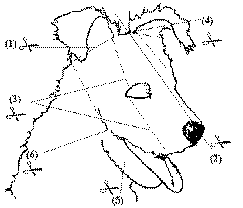
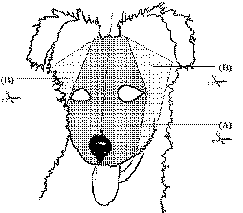
On the head you should pay attention that the skull and the cheeks don’t look too massive in comparison with the muzzle, so the cheeks should be cut fairly short. The profile of the head should be straight (no stop). The hair on the ears is rounded and trimmed. If the ears are heavy, you should cut more hair off and vice versa. It is good to cut more hair on the outside edges of the ears so that they look as well set as possible. If your Pumi’s ears fold over too far, cut as much hair as possible off the ears so there is less weight holding them down. Also you can trim the hair on the top of the head shorter to make the ears appear higher. The opposite is also true, if the ears stand too far up, leave more hair on the ears to hold them down. Pull out the hair that grows inside the ear canal (my Pumi hates this, but it’s better for their ear health).
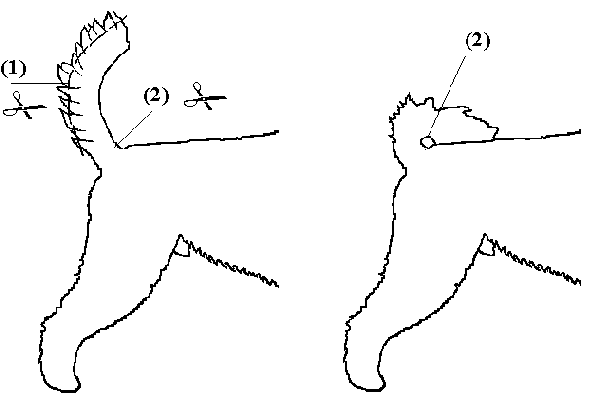
The hair on the tail is trimmed (1) and shortened so that the hair doesn’t “part” clearly. You should be able to see daylight (2) through the inside of the curl in the tail. The hair on the legs usually doesn’t need to be trimmed very much, but make sure the legs look straight and that the hair on the feet is rounded. Also be sure to cut and trim the nails.
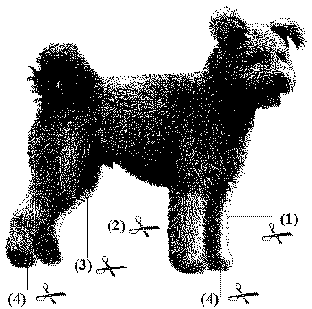
For further Information, you can view my video, Grooming a Pumi, on YouTube. I’ve also written a number of articles on Grooming to the Standard for the Hungarian Pumi Club of America’s newsletter which you can view if you’re a member.
Before a Dog Show
Tamara Langer: “We usually don’t scissor the hair before showing, or we do it only very carefully. Otherwise I usually prepare the coat of my dogs one or two weeks before the show and then I let it take up a natural form. That’s also the time when I bathe them with shampoo. The day before the show I just bathe them with clear tap water under the shower and let them dry.”
Grooming Tools
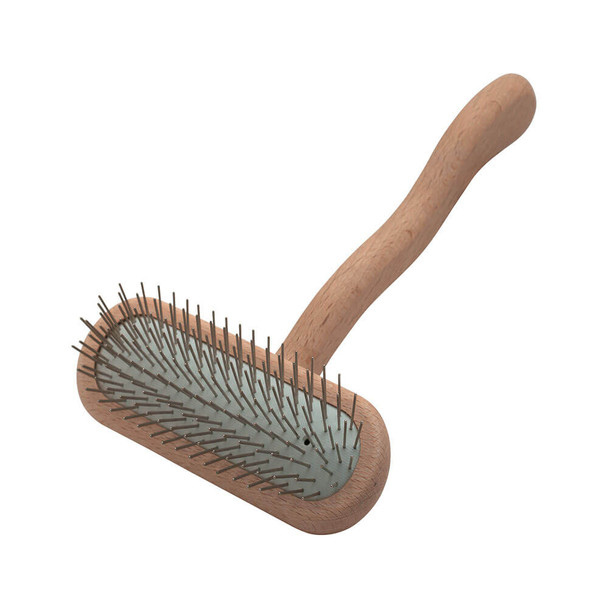
This is a great brush that will make your combing easier. It will take out most of the tangled hair (not hard-set mats) and then make it easier to run the comb through the hair. Use this before combing, but not as a substitute for a good combing. Hold the hair and comb bits of the hair away from what you’re holding, so that the hair becomes untangled a bit at a time. You can order it at https://www.cherrybrook.com/chris-christensen-original-series-t-brush/. Choose the 16mm Mini.
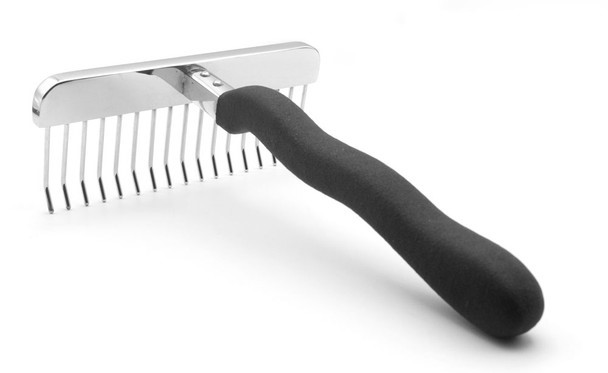
There’s a new comb/rake out that I’m really liking! It’s narrower and the tines are longer and wider apart which is great for picking apart tangles. It may become my new favorite rake. You can purchase it here: https://www.cherrybrook.com/chris-christensen-mini-t-rake-with-bent-pins/.

This is a comb that looks like a rake, but works great to comb the hair which should be done at a minimum of every 3 weeks (more often from 6-12 months old when they haven’t gotten their coarser, adult coat). You will get hair out when you comb, but then your puppy won’t be leaving hair lying around the house at other times. You can get the comb at this web site: https://www.amazon.com/gp/product/B073ZK287B/ref=ppx_yo_dt_b_asin_title_o00_s00?ie=UTF8&psc=1&pldnSite=1.
You can use any good dog shampoo, but not human as a dog’s pH is different than human. You shouldn’t bathe them more than once a month unless they’re getting really dirty. The nice thing about a Pumi’s coat is that they can get dirty and the dirt doesn’t seem to stay in the coat.

If you’re going to do the scissoring work yourself, you will also need to pull any hairs out of the ear canal that grow there. You can use these hemostats to do that more easily than tweezers. You can get them at this link: https://www.cherrybrook.com/millers-forge-pet-hair-puller-with-ratchet-5/. Get the 5″ straight ones.
You will also need shears to do the touch-up work and you can use any good hair shears that are at least 8″ long. Expect to pay at least $100 for decent ones. To choose the best shears for you, go to a large dog show that has at least one vendor selling shears and you can see which ones are most comfortable for you hand.
All but the comb can be obtained through www.showdogstore.com, so you only have to pay shipping once.